
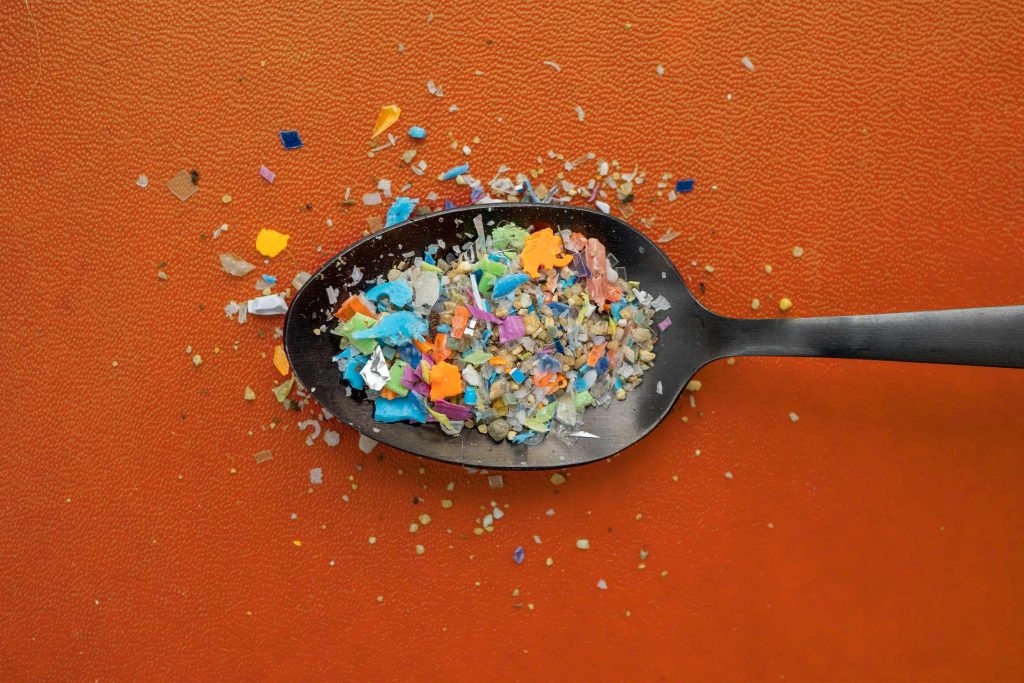
Microplastics—plastic particles less than 5 mm in size—have become pervasive across ecosystems, infiltrating not only oceans and soils but also the human food chain. Originally observed in marine environments, recent studies reveal their alarming presence in table salt, drinking water, seafood, and even fruits and vegetables (Toussaint et al., 2019; Zhang et al., 2020). The entry of microplastics into the human body via food and beverages raises critical concerns about long-term health impacts and regulatory oversight.
A 2022 report by the World Health Organization (WHO) acknowledged the growing evidence of microplastics in human tissues and emphasized the need for more toxicological studies. Alarmingly, microplastics can act as carriers for heavy metals, persistent organic pollutants (POPs), and endocrine-disrupting chemicals (EDCs), potentially exacerbating their health effects. Once ingested, particles smaller than 150 μm may cross the gut barrier and enter systemic circulation, reaching vital organs like the liver and kidneys (Wright & Kelly, 2017).
Moreover, trophic transfer—where microplastics move from prey to predator—amplifies the problem across food chains. Farmed fish, for instance, consume contaminated feed or water, allowing microplastics to accumulate and move up to human consumers. Microplastics have also been detected in human breast milk and placenta, underscoring the pervasive nature of this global threat (Ragusa et al., 2021).
Yet, microplastic pollution is not uniformly regulated. While the EU has introduced directives to reduce microplastic release from products like cosmetics and tires, there remains a lack of global consensus on permissible exposure limits. Without coordinated international policy, the contamination of the food chain is likely to worsen.
CRISPR 3.0: Precision Gene Editing with Reduced Off-Target Effects
CRISPR-Cas systems revolutionized gene editing, but early versions (notably CRISPR-Cas9) raised concerns about unintended mutations—so-called “off-target effects”—which can compromise therapeutic safety. The emergence of CRISPR 3.0, a term used to describe next-generation CRISPR tools, represents a leap toward enhanced precision and efficiency in genome editing.
Unlike its predecessors, CRISPR 3.0 incorporates high-fidelity Cas variants (e.g., Cas9-HF, eSpCas9) and newly engineered base editors and prime editors, which allow single-nucleotide edits without inducing double-stranded breaks (Anzalone et al., 2019). These innovations significantly minimize genomic instability and reduce off-target activity.
A notable advancement is the development of prime editing, which uses a fusion protein of Cas9 nickase and reverse transcriptase, directed by a prime editing guide RNA (pegRNA). This enables precise insertions, deletions, and all 12 types of base substitutions without requiring donor DNA or inducing DSBs (Lin et al., 2021). Additionally, CRISPR-associated transposases now allow for larger DNA insertions without cutting the genome at all, potentially useful for gene therapies or synthetic biology applications.
CRISPR 3.0 is also expanding beyond the genome. Epigenome editing platforms now allow scientists to silence or activate gene expression without changing the DNA sequence—an important shift for treating diseases like cancer, where gene misregulation rather than mutation is the primary concern (Liu et al., 2022).
Despite the promise, challenges remain. Delivery methods—especially in vivo—and potential immunogenic responses to Cas proteins are areas under active research. However, with better specificity, lower toxicity, and versatile applications, CRISPR 3.0 is rapidly becoming a cornerstone in precision medicine, agriculture, and biotechnology.
References:
- Anzalone, A. V., et al. (2019). Search-and-replace genome editing without double-strand breaks or donor DNA. Nature, 576(7785), 149–157.
- Lin, Q., et al. (2021). Prime editing with PAM-flexible Cas9 variants. Nature Communications, 12, 5816.
- Liu, Y., et al. (2022). Epigenetic modulation using CRISPR tools: State-of-the-art and future perspectives. Nature Reviews Genetics, 23, 715–732.
- Ragusa, A., et al. (2021). Plasticenta: First evidence of microplastics in human placenta. Environment International, 146, 106274.
- Toussaint, B., et al. (2019). Review of micro- and nanoplastic contamination in the food chain. Food Additives & Contaminants: Part A, 36(5), 639–673.
- Wright, S. L., & Kelly, F. J. (2017). Plastic and human health: A micro issue? Environmental Science & Technology, 51(12), 6634–6647.
- Zhang, Q., et al. (2020). Microplastics in human consumables: Food, drinking water, and air. TrAC Trends in Analytical Chemistry, 130, 115980.


